

Recycle plastic into foam
Biodegradable plastic is considered good for the environment. However, because they are specifically made to decompose quickly, they cannot be recycled.
In the journal Physics of Fluids, researchers from the University of Canterbury in New Zealand have developed a method of turning biodegradable plastic knives, spoons and forks into a foam. Thanks to this, this type of foam can be used as insulation in walls or flotation devices.
The researchers placed the utensils, previously thought to be “non-foamable” plastic, into a chamber filled with carbon dioxide. As the pressure increases, the gas dissolves into the resin. When the pressure in the cavity is suddenly released, the carbon dioxide expands inside the plastic, creating foam. Study author Heon Park said the process is similar to opening a can of soft drink and releasing carbonation. “Adjusting temperature and pressure, that's a window where we can create good foam, not every temperature or pressure will work. We figured out what is the best temperature or pressure to turn those non-foaming plastics into foam,” said Mr. Park.
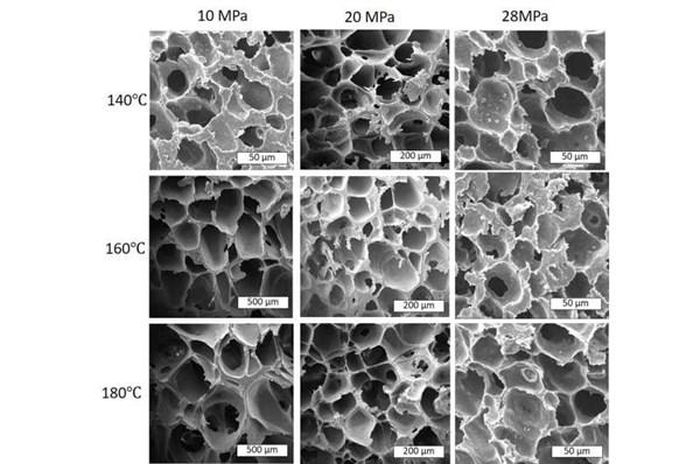
Foam structure at different temperature and pressure levels.
Each time it is recycled, plastic loses its durability. Meanwhile, foam is an ideal new material. Because, they do not require durability in many applications.
“Whenever we recycle, every time, we decompose plastic. Let's say we have a biodegradable spoon. We use it once and recycle it into another spoon. It can break in your mouth,” researcher Park explained. The ideal structure of foam depends on its end use. For example, large foam is said to be very good for float applications. The researchers found that, contrary to what was previously thought, lower pressure in the chamber resulted in large bubbles. Making biodegradable plastics recyclable could alleviate some of the global pollution problems. Biodegradable materials will eventually decompose in nature. However, the fact that plastic can be reused will bring great benefits to the environment.
Plastic is biodegradable and recyclable for multiple uses. However, plastic will pose a major threat to the environment, if it is thrown into oceans or landfills. The team believes that this process can be done on a large scale. “We can expand foaming applications to many types of plastics. Not just this type of plastic,” Mr. Park said.

Asia's Trusted Partner in Innovative Foam, Film & Elastomer Solutions
Lot 8, TS6 road, Tien Son IZ, Tien Du, Bac Ninh province, Viet Nam